20 de agosto de 2026
Share
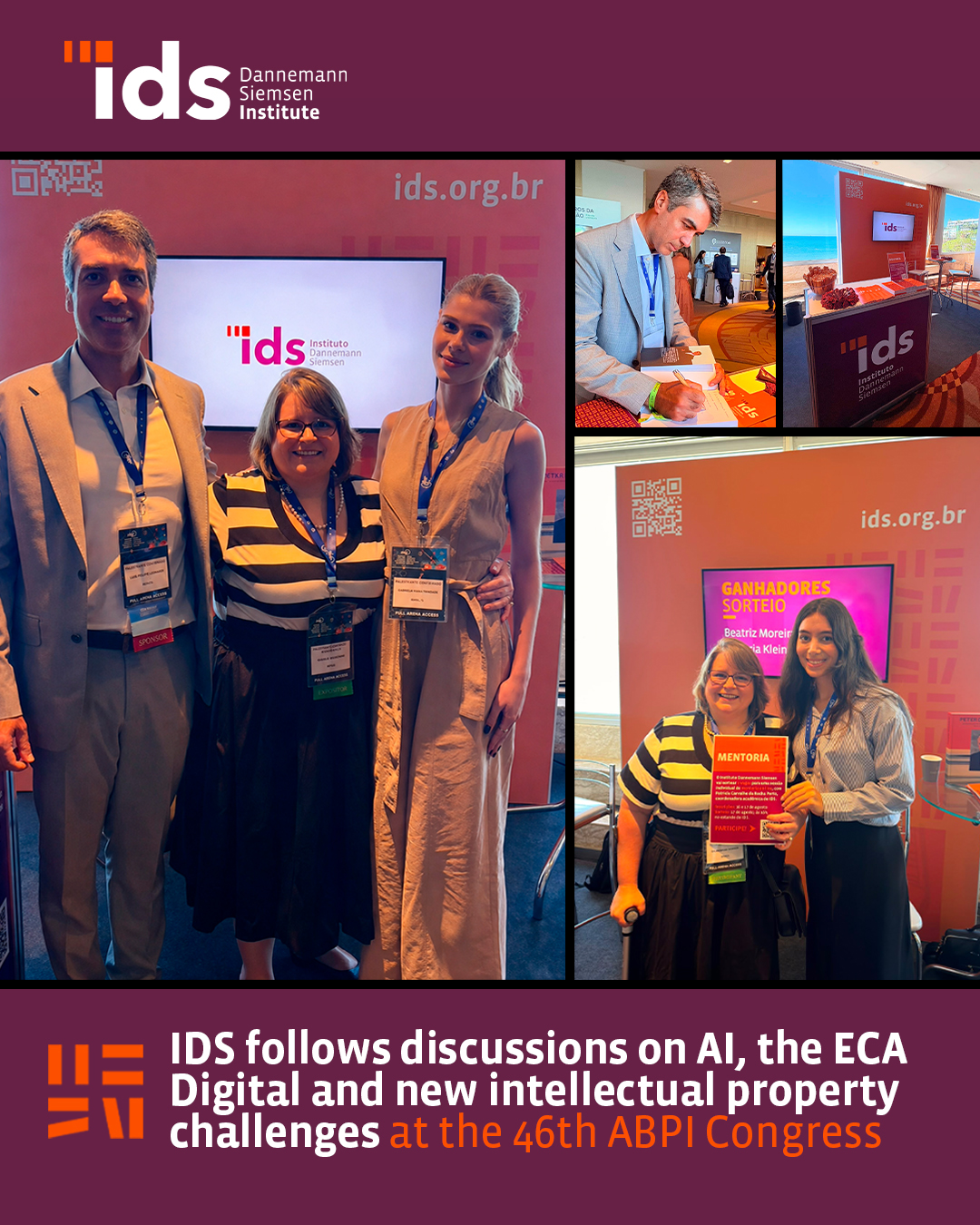
IDS follows discussions on AI, the ECA Digital and new intellectual property challenges at the 46th ABPI Congress
The Dannemann Siemsen Institute (IDS) was present throughout all three days of the 46th International Congress of the Brazilian Intellectual Property Association (ABPI), held from August 16 to 18 in Rio de Janeiro. This year, the Congress, entitled the Global Meeting on Innovation and Intellectual Property, adopted a new format structured around three thematic arenas: Arena 1 – New Technologies & Artificial Intelligence; Arena 2 – Innovation & Entrepreneurship; and Arena 3 – Business & Strategy in Intellectual Property.
The IDS participated as an institutional supporter, with its own booth, and was represented by its Executive Director, Filipe Fonteles Cabral; Academic Coordinator, Patricia Porto; and Junior Research Analyst, Marcela Schmidt. Filipe also served, alongside Fernanda Magalhães, as a Scientific Coordinator of the event.
The program began on Sunday (August 16) with IP Youth Day, dedicated to professional development and career paths in the field. The program featured Lizbeth Pagola, PepsiCo’s General Counsel, as keynote speaker, in a discussion on career, transformation, and resilience. The official opening of the Congress followed, with the participation of Peter Eduardo Siemsen, President of ABPI; Julio Lopes, President of the Joint Parliamentary Front for the Defense of Intellectual Property and the Fight Against Piracy and Federal Deputy; Júlio César Castelo Branco Reis Moreira, President of the Brazilian Patent and Trademark Office (BPTO; and Pedro Ivo Sebba Ramalho, Secretary for Competitiveness and Regulatory Policy at the Ministry of Development, Industry, Foreign Trade and Services (MDIC).
Among the topics highlighted during the opening session were the strengthening of intellectual property as a tool for competitiveness and innovation, the institutional modernization of the BPTO, and the continuation of public policies aimed at advancing Brazil’s IP system. The BPTO’s objectives were also emphasized, including making its services increasingly efficient for users and society, reducing the time required to grant IP rights, and strengthening cooperation between the public and private sectors.
The opening program also featured panels on professional trajectories. Lars Grael, Brazilian sailor and Olympic medalist, shared his experiences on resilience and leadership. Maria Silvia Bastos Marques, a member of Klabin’s Board of Directors and former President of BNDES, then discussed her career and issues related to management, productivity, and innovation.
Over the three days, IDS attended panels addressing a range of topics, including the debate on artificial intelligence regulation, which brought together Caroline Tauk, Federal Judge of the Federal Regional Court of the 2nd Region; Ali Mirsaidi, Partner at Perkins Coie; and Dora Kaufman, Professor at PUC-SP. Among the issues discussed were the authorship of inventions developed with the assistance of AI and the use of protected content in the training of models.
The panel examined the challenges of adapting the intellectual property system to the advancement of artificial intelligence, particularly with regard to the authorship and ownership of inventions developed with the assistance of AI and the use of protected works in training generative systems. Regulatory proposals currently under consideration in Brazil were also discussed, as well as the need to reconcile transparency, rights protection, remuneration of rights holders, and technological feasibility. The discussion further highlighted the practical challenges of enforcement and the transaction costs associated with large-scale licensing models.
Another topic followed by IDS was the Digital ECA, in a panel featuring Lílian Cintra de Melo, former National Secretary for Digital Rights; Ricardo de Lins e Horta, Director of Security and Risk Prevention in the Digital Environment at the Ministry of Justice and Public Security; and Camila Leite Contri, General Coordinator for Technologies and Digital Environments at the Brazilian Data Protection Authority (ANPD).
The discussion addressed the development of mechanisms to protect children and adolescents in the digital environment, with particular emphasis on the shift from a reactive approach toward preventive and precautionary measures. In this context, the panel discussed a layered protection model combining age ratings, parental controls, age verification, and safety by design in products and services, as well as the effects of platform architecture and design, loot boxes, and engagement mechanisms on minors. The challenges of age verification were also examined, particularly with regard to minimizing the collection of personal data, along with the concept of “probable access,” based on the likelihood of use, ease of access, and level of risk in determining which services should be subject to Digital ECA obligations.
The panel “Influencer 2.0: AI, Transparency, and the Future of IP Law” featured Etienne Sanz de Acedo, CEO of the International Trademark Association (INTA), and Juliana Albuquerque, Executive Vice President of CONAR. The panel examined the transformation of influencer marketing through the incorporation of artificial intelligence and the emergence of new content creator models, including virtual and synthetic influencers. The evolution of the market was also linked to the growth of micro- and nano-influencers and the increasing demand for transparency in relationships among brands, creators, and consumers.
From an intellectual property perspective, the discussion addressed the impact of text and data mining on the development of AI systems, particularly regarding the use of protected content, licensing, opt-out mechanisms, remuneration, and transparency, taking into account different international regulatory approaches. In the advertising field, the panel discussed the identification of commercial content produced by influencers and the liability of participants throughout the advertising chain, as well as new challenges arising from AI, such as synthetic content, avatars, and digital recreations, underscoring the importance of updating self-regulatory guidelines and internal governance mechanisms.
Finally, the panel “Intellectual Property and Sports” brought together Ingrid Grandini, Division Coordinator at the CBF’s National Dispute Resolution Chamber (CNRD); Rhyan Ribeiro, Corporate Counsel at Vasco da Gama; and Victor Targino, Global Legal Counsel at Sporty Group. The discussion demonstrated how IP intersects with different dimensions of the sports industry, from trademarks and copyright to contracts, broadcasting, and technology. One of the key points was the distinctive nature of fans as consumers, for whom a club’s distinctive sign may carry value extending beyond the objective characteristics of the product, reinforcing the strategic importance of trademark protection. The panel also addressed the specific challenges posed by eSports and the growing commercial exploitation of digital assets.
IDS’s participation in the 46th ABPI Congress reinforces its commitment to monitoring developments in intellectual property in Brazil and its intersection with emerging technologies, innovation, and different sectors of the economy.
Note: For quick release, this English version is provided by automated translation without human review.