14 de julho de 2026
Share
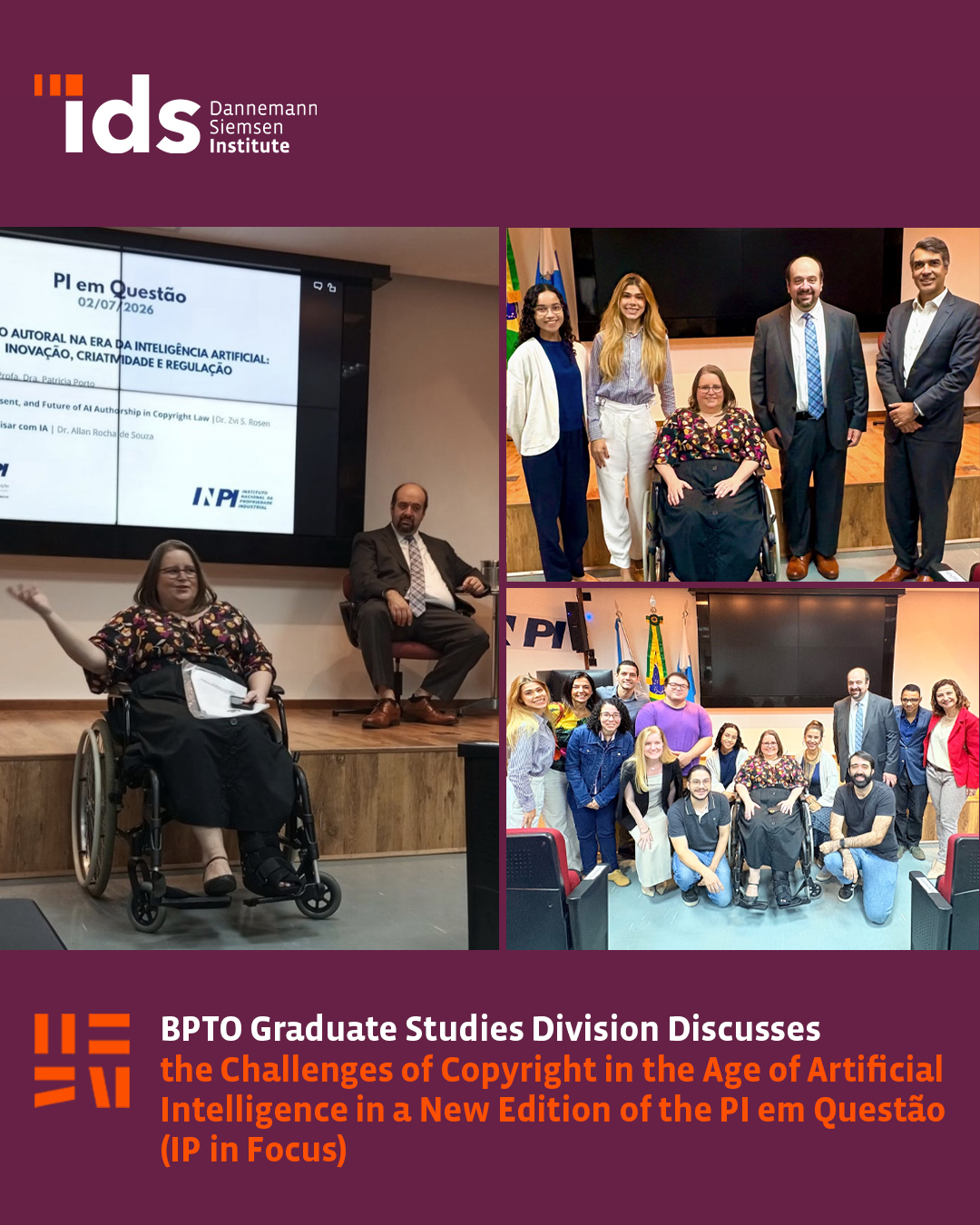
BPTO Graduate Studies Division Discusses the Challenges of Copyright in the Age of Artificial Intelligence in a New Edition of the PI em Questão (IP in Focus)
On July 2, the Graduate Studies Division of the Brazilian Patent and Trademark Office (BPTO) hosted another edition of its PI em Questão (IP in Focus) seminar series, this time dedicated to the theme “Copyright in the Age of Artificial Intelligence: Innovation, Creativity, and Regulation.” Held in a bilingual format (Portuguese and English), this edition was supported by the Dannemann Siemsen Institute (IDS) and fostered a discussion on key issues at the intersection of intellectual property and artificial intelligence (AI). Among the topics discussed were the authorship of works created with the assistance of AI, the legal protection of content generated by generative AI systems, and the emerging regulatory challenges posed by this technological innovation.
The event was scientifically coordinated and moderated by Patricia Porto, Professor in the Graduate Program in Intellectual Property and Innovation at the Brazilian Patent and Trademark Office (PPGPI/INPI) and Academic Coordinator of the Dannemann Siemsen Institute (IDS). It featured a keynote lecture by Professor Zvi Rosen of the UNH Franklin Pierce School of Law, followed by a discussion with Professor Allan Rocha de Souza, Professor in the Graduate Program in Public Policy, Strategies and Development (PPED) at the Institute of Economics of the Federal University of Rio de Janeiro (IE/UFRJ) and President of the Brazilian Copyright Institute (IBDAutoral).
In his lecture, titled “Past, Present, and Future of Authorship by Artificial Intelligence in Copyright Law,” Zvi Rosen showed that the debate on authorship by machines is far less new than is commonly assumed. Starting from the U.S. constitutional basis, which conditions protection on the existence of a “writing” and an “author,” the professor recalled that Title 17 of the U.S. Code does not define what an “author” is, although it is understood that it must be a natural person. In this regard, in American case law the Feist v. Rural Telephone case stands out, having established originality, however minimal, as the central requirement of authorship and of its subsequent protection.
Rosen emphasized that the US Copyright Office (USCO) has dealt with computer-generated works since the 1960s, setting out, in a 1965 memorandum that already grappled with the issue, the criterion that remains in force today, in which the machine must function as a mere instrument of the human author, and not as the autonomous origin of the work. Recent cases, such as the denial of the registrations sought by Stephen Thaler (Thaler v. Perlmutter, involving the DABUS system) and by Jason Allen (Allen v. Perlmutter, concerning an award-winning work generated with Midjourney), reaffirm the understanding that the use of AI as a tool does not preclude protection, provided that the human controls and channels the expression, whereas the mere “adoption” of a result generated autonomously by the machine does not constitute authorship. The speaker also explored the notion of mediated authorship, likening AI to other forms of creation that involve, for example, intermediaries — in the historic Burrow-Giles v. Sarony case (1884), concerning a photograph of Oscar Wilde, in which the Supreme Court defined the author as the “inventive mind” who oversees the arrangement, even without operating the technical equipment.
Next, Allan Rocha de Souza framed copyright as an institution historically tied to technological innovation, from the movable-type press to photography and software, in successive cycles of disruption and social acceptance. In his analysis, the spread of content generated by artificial intelligence ushers in a scenario of high-volume production, which brings new challenges to the traditional mechanisms of copyright law. The professor further proposed a reflection on what it means to create, stressing that what prevails is the human creative decision that conceives, guides, and determines the final expression, such that the technique employed — like the use of generative AI — is merely a means to achieve the result, with the human element that guided the process standing out.
The meeting closed with a productive question-and-answer session with the in-person and online audience, which addressed themes such as utilitarian and market-based approaches in copyright law, the ethics of training models with human data, the impacts of AI on academic research, and the possibility of copyright protection for prompts — a hypothesis that, the speakers concluded, depends on the degree of original expression contained in them.
By bringing together the historical perspective of U.S. copyright law and a critical look at the direction of regulation in Brazil, the event showed that the challenges posed by artificial intelligence, far from being unprecedented, revive a centuries-old debate on the meaning of authorship. The conclusion of the meeting reaffirmed the centrality of human creation as the foundation of copyright protection, while also pointing to the need for the legal system to keep pace, with balance, with the technological transformations underway.
The recording of the event can be accessed through INPI’s YouTube channel: PI em Questão: Copyright Law in the Era of Artificial Intelligence – Innovation, Creativity and Regulation – YouTube
Note: For quick release, this English version is provided by automated translation without human review.