11 de agosto de 2026
Share
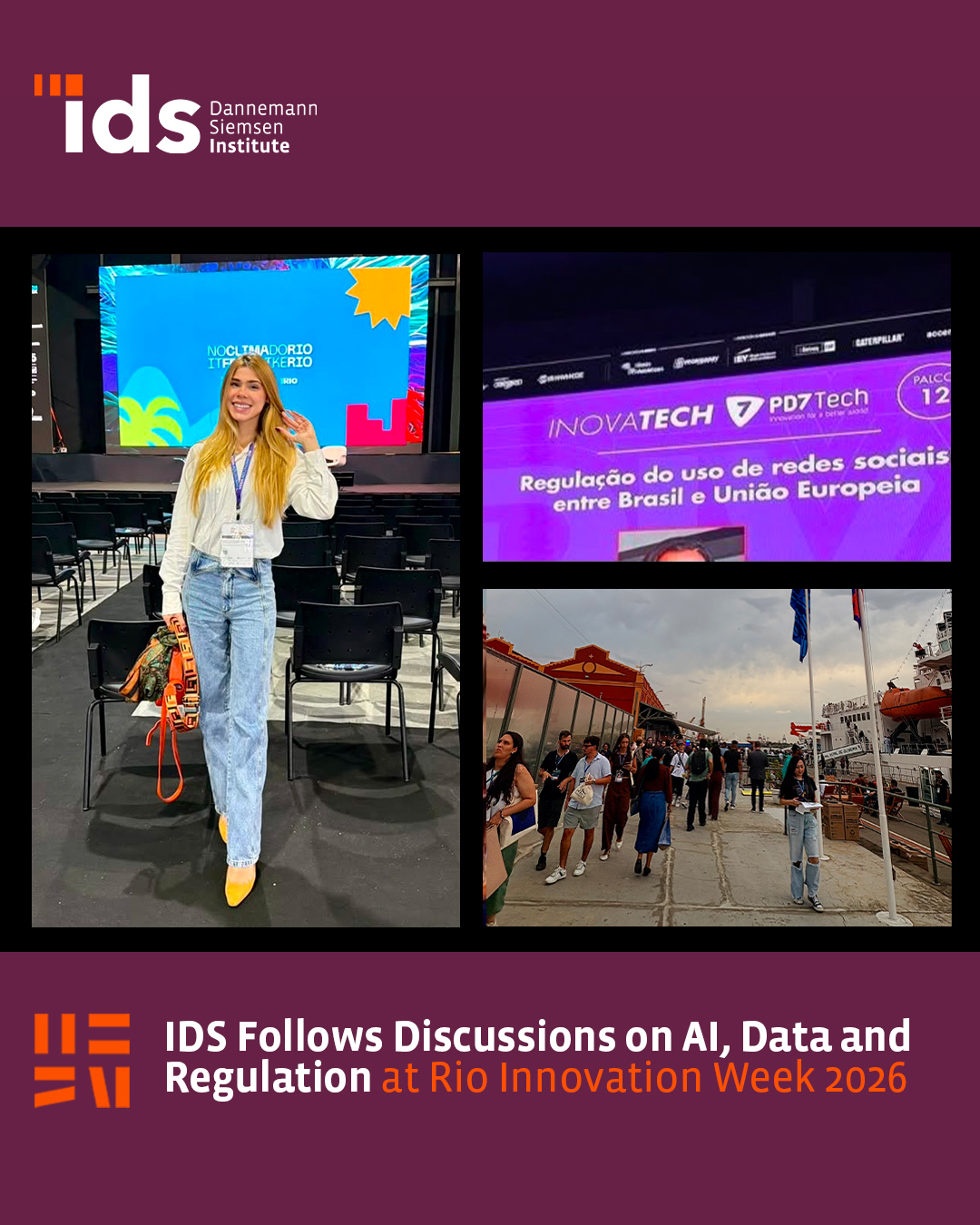
IDS Follows Discussions on AI, Data and Regulation at Rio Innovation Week 2026
Held from August 4 to 7 at Píer Mauá in Rio de Janeiro, Rio Innovation Week brought together discussions on artificial intelligence (AI), technology, and innovation. On Friday, August 7, IDS attended panels addressing the regulation of digital platforms, the regulatory implications of AI, and the application of new technologies in legal practice.
The regulation of digital platforms was discussed through a comparison between Brazil and the European Union. Thaiana Conrado Nogueira, from the Municipality of Niterói, emphasized that the debate concerns not only platform liability, but also the contemporary understanding of freedom of expression and democracy. In this context, the discussion addressed phenomena such as “echo chambers,” in which content circulates predominantly within groups with similar views, as well as biases resulting from the personalization of information provided by social media platforms.
The presentation focused on the Digital Services Act (DSA) and the Digital Markets Act (DMA), the European Union’s main regulatory frameworks for digital platforms and markets. According to the speaker, one of the DSA’s central features is the shift from a predominantly punitive approach to one focused on the prevention of systemic risks. Rather than acting only after harm has occurred, the regulatory framework seeks to require platforms to implement mechanisms to identify and mitigate, in advance, risks related to the circulation of illegal content and the manipulation of the information environment. The 2024 European elections were identified as an initial significant test of this model, which also appears to have fostered greater cooperation between platforms and public authorities through the sharing of data, documents, and reports.
In Brazil, this preventive approach was discussed in connection with recent changes introduced by the Federal Supreme Court (STF) regarding Article 19 of the Brazilian Internet Civil Rights Framework (Marco Civil da Internet), as well as measures adopted by the Executive Branch. Although similarities exist with the European model, the speaker highlighted an institutional distinction: while the DSA was established through legislation, a significant portion of the new obligations applicable to platforms in Brazil has been developed through judicial decisions and Executive Branch measures, in the absence of a broader legislative framework on the subject. The discussion also addressed deepfakes and disinformation, particularly during electoral periods. According to the speaker, regulating platforms does not necessarily entail restricting freedom of expression and may also serve to preserve it in the face of false content produced and disseminated at scale.
The regulatory implications of AI were also discussed by Pedro Saliba, Coordinator at Data Privacy Brasil; Sérgio Branco, Director of the Institute of Technology and Society (ITS Rio); and Adriana Rollo, attorney. Pedro Saliba noted that existing rules, including the Federal Constitution, the Civil Code, the Consumer Protection Code, and the Brazilian General Data Protection Law (LGPD), may already apply to the use of AI, while the specific characteristics of the technology nevertheless warrant dedicated legislation. The discussion surrounding Bill No. 2,338 focused on the classification of AI systems according to their level of risk and the need to balance harm mitigation with technological development, particularly in areas such as healthcare and education.
Copyright was identified as one of the main areas of tension. Sérgio Branco noted that there is still no established business model for the use of copyrighted works to train AI systems. He drew a comparison with the changes brought about by the online distribution of music, when the initial challenges were not resolved directly through legislation, but rather through the development of new business models, such as streaming, which reshaped the ways in which works were distributed and authors were remunerated. In this regard, he noted that the current AI challenge is similar: to develop economically viable solutions that allow authors to be remunerated without creating excessive barriers to innovation. Competition is also a concern: large technology companies have the resources to negotiate agreements directly with rights holders, whereas startups may lack comparable financial capacity, potentially increasing barriers to market entry.
Sérgio Branco also highlighted differences between the regulatory frameworks. According to the speaker, the European Union and the United States allow, under certain circumstances, the use of publicly available content to train AI systems, such as posts on platforms like LinkedIn, whereas the Brazilian bill adopts a more restrictive approach based on the remuneration of rights holders, although it provides for certain exceptions. For the speaker, this difference may affect competition and market development, particularly given the territorial nature of copyright protection. As the Berne Convention provides that infringements must be addressed in the country where they occur, difficulties may arise when the same use is considered lawful in one jurisdiction but subject to remuneration requirements or regarded as infringing in another.
Another issue discussed was the use of confidential information in AI tools. Participants emphasized that the convenience offered by these platforms may lead users to underestimate the risks associated with sharing data. Suggested measures included removing personal and sensitive information before uploading documents and, where possible, using locally deployed models or enterprise solutions that provide greater control over data.
Finally, the panel “The Engineer-Lawyer: Where Law, Data, and Technology Converge” examined how technology can transform the way legal services are provided. Regina Acuto, founder of Verifact, explained how difficulties in using screenshots as evidence led her to develop a solution aimed at preserving the authenticity, integrity, and chain of custody of digital evidence. Mariana Carvalho, Legal Director of TikTok in Brazil, discussed the company’s restructuring of its litigation function through the organization and analysis of data. This approach enabled the company to identify litigation patterns, anticipate issues, and move from a reactive approach to a preventive litigation strategy, resulting in a reduction in the volume of litigation. These examples underscored that, in the legal field, the value of technology lies not only in automating tasks, but also in its ability to transform data into actionable information for decision-making and risk prevention.
The discussions attended by IDS demonstrated that the legal challenges associated with digital technologies extend well beyond the question of regulation. These technologies are already having concrete effects on freedom of expression, platform liability, data protection, copyright, and legal practice. Against this backdrop, the regulatory challenge is to prevent risks without undermining innovation, while preserving fundamental rights and meaningful human involvement in decision-making processes.
Note: For quick release, this English version is provided by automated translation without human review.